
The media for well-designed interiors
Ideas, tips and inspiration for making the most of every space. From the kitchen to other living areas, we explore the materials, uses and choices that make for successful interiors.
Read the cooking guide
6 questions to ask yourself before a kitchen renovation
What budget is required?
The budget will be the cornerstone of your project. Materials, labour, equipment: plan ahead for every line item.
What is the available space?
The smaller your kitchen, the more you’ll need to optimize its layout.
Why renovate your kitchen?
Accurately calibrating your needs will allow you to set a consistent budget and stay within it.
Do you have time to spare?
A renovation project that drags on could turn out to be quite a nuisance. Plan ahead for the time factor.
Which artisan should you choose?
Word of mouth, experience, price: compare professionals before you commit.
Do you need a kitchen architect?
Optimising space, improving circulation and the use of your kitchen: that is the architect’s work.
What budget is required?
As with everything, budget will certainly be the cornerstone of your upcoming kitchen renovation project. Whether it’s a makeover or a complete overhaul, a renovation project often involves several professionals, and the cost of labour and/or materials can quickly turn out to be higher than you had anticipated. To avoid letting the bill spiral out of control, it’s best to plan very precisely the budget you allocate to your renovation work.
For a kitchen renovation, your budget will include:
Price of a kitchen installation
The assembly of a kitchen’s structure is not the most expensive component when it comes to renovating your living space. However, it accounts for approximately 15% of the total cost of your project (around €100/m², excluding materials) and can quickly escalate depending on the tradesperson or company you hire.
Note that you can call directly on the kitchen designer to come and install your brand new kitchen at home, or alternatively purchase the kitchen structure and then contact a craftsman of your choice for the installation stage.
Whatever your choice, don’t forget that you benefit from a reduced VAT rate of 10% on labour and materials when renovating a kitchen in a home that is more than two years old.
Price of a kitchen
A fixed estimate for a kitchen doesn’t exist. Why? Because it depends on a very large number of factors, including the kitchen range, its configuration (fitted or not), the materials used, the surface area, and the accessories and appliances purchased at the same time. Budget between €1,000 and €5,000 for an entry-level fitted kitchen and €5,000 to €10,000 for a mid-range fitted kitchen, excluding installation.
Price for removing a kitchen layout
And yes: as part of a renovation, the removal of an existing kitchen must be factored into the budget. Generally, you should expect a flat fee of between €200 and €500.
Reducing costs with a flat-pack kitchen architecture
The installation price for a flat-pack fitted kitchen, excluding materials, is generally between €300 and €1,200, whereas that of a traditional kitchen averages between €800 and €5,000. Flat-pack kitchens are available in several ranges of varying quality. Budget an average of €5,000 for a mid-range kitchen made up of standard units. Ask in-store specifically about this. Beforehand, also check with your tradesperson whether their services include the installation of a flat-pack kitchen layout.
Key figures

What is the available space?
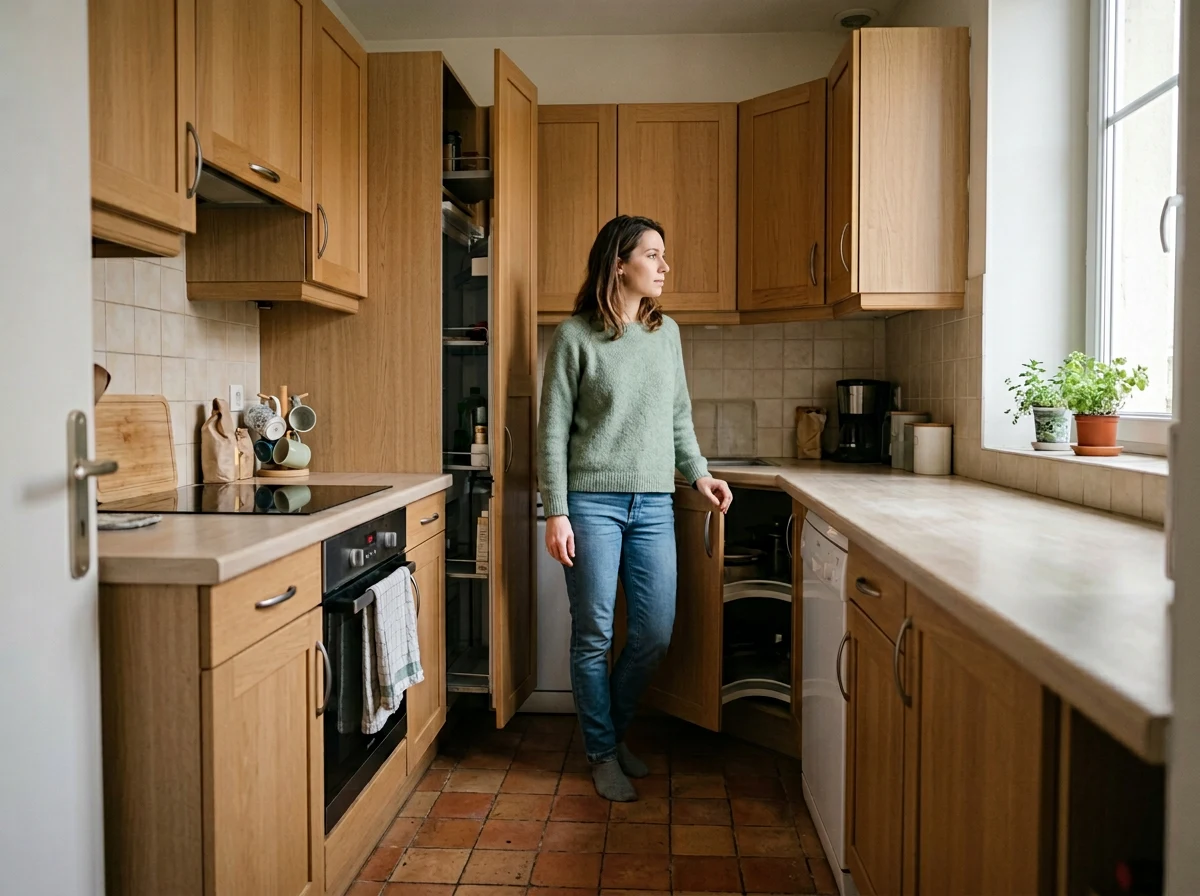
The circulation aisles must measure at least 80 cm, regardless of how compact your kitchen is.
It is not always possible to imagine every creative idea for your kitchen renovation. Beyond the budget, how much space do you have? The smaller your floor area, the more you will need to think about optimising the layout of your kitchen. It is therefore a matter of knowing how to arrange your kitchen.
Small spaces: the right habits to adopt
In a small space, opt for vertical storage in the form of shelves — large cupboards might actually make the room feel smaller. Lacquered and satin finishes catch the light more effectively and are therefore the better choice for compact spaces.
Why renovate your kitchen?

Do you have a real need to renovate your kitchen? This renovation can perhaps wait. Maybe all you need is to repaint your backsplash, after all. Properly assessing your needs will help you understand what type of kitchen you require, set a realistic budget, and most importantly, stick to it.
Keep in mind that there are many tricks to give your kitchen a makeover on a budget by specifically targeting the appliances or furniture you want to get rid of.
Do you need authorization from the co-ownership?
As a general rule, renovating your kitchen will not require any authorization from your co-ownership, unless you wish to work on a load-bearing wall or your work does not comply with the intended use of the building. You will, however, need to reach out to the other owners and tenants to inform them of the potential noise disturbances caused by the work.
Do you have time to dedicate to this renovation?
Unless you opt for home staging, renovating a kitchen often takes time. When it comes to a complete overhaul, you will need to entirely rethink the existing kitchen layout. You will therefore need to set aside time for:
The development of your need
Seeking financing from a bank
Prospecting different kitchen designers and comparing quotes
The selection of complementary craftsmen in the event that you have your kitchen installed separately
The removal and installation work
The site cleanup
The kitchen being a living space, a renovation project that drags on could prove quite disruptive. Be sure to take this time factor into account when planning your project.

Which craftsman to choose for your renovation?
You’re looking for a specialist craftsman to install your kitchen cabinets? In that case, start by reaching out to your personal network. Word of mouth works very well, and the recommendations you gather will undoubtedly be more relevant than those from strangers scattered across the web.
Perform a search by sector using an internet search, then compare the different professionals based on:
Their experience
An experienced craftsman will have already encountered the specific challenges of your kitchen configuration and will know how to address them effectively.
The maturity of the company
Often a guarantee of quality services, the maturity of a company reflects its reliability and the satisfaction of its clients.
The craftsman’s speech
A professional who is transparent about their methods, timelines, and limitations inspires confidence. Be wary of overly vague or evasive language.
The price of the service
Compare quotes in detail. A price that seems too low often hides incomplete services or lower-quality materials.
Execution deadlines
Availability and adherence to announced deadlines are essential to avoid unnecessarily prolonging a kitchen renovation project.
Beware, an offer that seems too good to be true should always raise your suspicions. Kitchen installation requires careful workmanship, especially since it often involves plumbing and electrical work. You wouldn’t want to rush into things just to save a few euros, would you?
Is it necessary to call on a kitchen architect?
Who hasn’t dreamed of owning a beautiful architect-designed kitchen, both aesthetic and high-quality, where the whole family feels at home?
Whether you have a small space or a larger kitchen, hiring a kitchen architect can be a wise decision, if your budget allows. The difference is particularly noticeable when your space is somewhat tight or your kitchen layout is unusual. Optimising space, improving flow and enhancing the functionality of your kitchen — that is the architect’s job.
It is worth noting that many kitchen architecture firms have partnerships with kitchen brands, allowing you to benefit from the best possible value for money.

What furniture for a kitchen renovation?
Style contemporary, rustic or modern… in kitchen furniture, there is no shortage of choice to give character to your kitchen.
15 to 60 € per linear meter for installation, between 15 and 600 € per m² for materials, depending mainly on the material used. When it comes to worktops, stone is the most expensive material (granite, etc.), closely followed by composite materials. Polished concrete, tiles, and metal are reliable alternatives if you want to save a little more on the cost of your kitchen design.
The upper and lower cabinets in your kitchen make up the largest part of what is seen when you enter the room. Which ones will you choose? The price range generally varies between €50 and €350 including installation for an upper cabinet, and between €80 and €350 for a lower cabinet.
Very popular, the kitchen island has a dual advantage: it provides additional workspace and dining space while adding character to the kitchen. It is indeed a hallmark of modernity. Available in all sizes, the kitchen island is sure to impress. Choose one in the same tone and at the same height as the rest of your kitchen furniture, and make sure to maintain a distance of approximately 1.2 m around the island to allow for easy movement throughout the home.
Choose your range hood based primarily on its size, airflow mode, and air output. Its shape can also be a deciding factor: built-in hood, slide-out hood, or canopy? The latter is among the easiest to install. Note that there are two main types of range hoods: ducted or recirculating. The first type, more efficient and quieter, does however require the presence of an exhaust duct. Given all these criteria, you will find kitchen range hoods at every price point, ranging from €100 to €2,000.
Reusing existing furniture: the key principles of home staging
The kitchen is one of the most cherished living spaces for French homeowners. We spend a great deal of our time there, with family or friends. Renovating your kitchen is therefore far from a trivial undertaking. However, finding the budget to do so can be more complicated than expected.
If you have a minimal investment, why not opt for home staging? This technique involves giving your living space a fresh new look by making the most of your existing kitchen architecture.
Apply adhesive films to your kitchen cabinet doors instead of replacing them. Sometimes that’s all it takes to give your kitchen a dramatically fresh new look!
Change your cabinet handles for more contemporary versions. You’ll find a wide range of affordable options at your local hardware store.
Replace just a few key elements in your kitchen: the sink, the backsplash, or the hob, for example.
Paint your water-resistant backsplash or cover it with a coating rather than removing it. Do the same for your floor covering!
Replace your kitchen accessories and furniture: mirror, table or kitchen chairs, curtains… The smallest detail can make all the difference.
When it comes to home staging, there is no shortage of examples. Find inspiration online, ask for advice at a DIY store, or consult an architect who specialises in the field. It’s all about visualisation!
What materials for a kitchen renovation?
The choice of materials is personal to each individual, and will largely depend on your tastes and how you intend to use them.
Designing a kitchen that stands the test of time without losing its style.
Here, you’re not just choosing a finish. You’re weighing durability, maintenance, budget, visual warmth, and a material’s ability to age gracefully.
The right mix here: a signature material + a utility material + a finish that tones everything down. It’s that contrast that creates the premium feel.
Floor coverings in a kitchen
Resistant • Non-slip • BudgetIdeally, the flooring for a kitchen should be impact-resistant, non-slip, aesthetically pleasing, and affordable. While there are a range of solutions on the market that meet these criteria, they are not always easy to find. Which flooring is best suited to your renovation project?
Tiling, available in small tiles or XL slabs, in every colour and at every price point. Highly customisable, hygienic and durable, it has more than one trick up its sleeve. Opt for natural stone, terracotta tiles or cement tiles for a bolder aesthetic.
Hardwood flooring is also a viable option in a kitchen. The financial investment will be greater, and you will need to choose an exotic wood species that is naturally water-resistant. If this doesn’t fit your budget, porcelain stoneware is a formidable alternative: it mimics raw wood and concrete, and can be installed on both floors and walls.
PVC vinyl, in planks or tiles, is one of the most affordable flooring options. It is easy to install, simple to maintain, and offers nearly endless customization possibilities. On the other hand, it scratches more easily, has poor impact resistance, and benefits from an additional protective coating.
In an open-plan kitchen, think about visual continuity: do you want to mark the separation from the living area, or go for a unified look? This is where the material becomes an architectural tool, not just a finishing touch.
The backsplash in a kitchen
Protection • Style • Easy cleaningThe kitchen splashback is one of the essentials when it comes to renovation. It comes in a multitude of different colours and styles. Stone, cement tile, oak or even glass splashbacks — all kinds of designs are possible and… at every price point. Beyond its aesthetic appeal, the splashback protects walls against splashes and spatter from everyday use.
Beyond the traditional tiled finish, you can opt for a stainless steel model for a bold aesthetic and easy maintenance. Expect to pay between €20 and €80 / m² approximately.
Glass has the same visual and practical qualities, but tends to be more expensive: from around €250 per m².
For a more industrial style while keeping costs under control, you can opt for a polished concrete coating, which is durable and easy to pair with all types of worktops. Expect to pay around €25 / m², with installation carried out by a professional and non-abrasive maintenance required.
To reduce costs, an adhesive backsplash applied over an existing surface remains a popular option. Plastic is the most budget-friendly alternative, even though it is less durable and less attractive.
Last aesthetic tip: a low splashback, between 10 and 20 cm, is an excellent choice for small kitchens. It visually enlarges the space and gives the overall design a more contemporary feel.
Choosing the right splashback for your range hood
Hot zone • Safety • DurabilityThe choice of splashback is essential: it sits in direct contact with the cooking plates. Stainless steel is very well suited for this purpose, as is laminate. However, be careful: the latter is only suitable for induction hobs, as it has very little resistance to direct heat.
Visually, it’s the perfect place to introduce a more radical material. Technically, it’s also the area where aesthetic choices must never take precedence over thermal resistance.
The ceiling of a kitchen
Painting • Suspended Ceiling • DampCeiling finishing is very often neglected during renovation work. Yet, in a heavily used living space such as the kitchen, a originally white ceiling can quickly become dull or damaged. When it comes to ceiling coverings, paint remains the most widely used option.
You can opt for a water-resistant acrylic paint, suited to daily use and more reliable in environments exposed to humidity.
Oil-based glycero paint is also a viable option if you’re looking for a durable finish, provided you carefully manage the application process and site ventilation.
You can also install a false ceiling, an interesting solution for integrating light fixtures, visually correcting the volume, and giving the whole space a more architectural finish.
The ceiling is often invisible until the moment it’s done wrong. Treated well, it calms the composition, reflects light more effectively, and gives the entire kitchen the feeling of a finished room.
When it comes to renovation, the right combination isn’t the one that multiplies effects. It’s the one that strikes the perfect balance between durability, maintenance, cost, and visual impact. A well-designed kitchen speaks as much through its proportions as through the quality of its materials.
FLOOR • SPLASHBACK • HOOD • CEILINGWhat materials should you use for a kitchen renovation?
The choice of materials is personal to each individual, and will largely depend on your tastes and how you intend to use them.
Expert Blog

Want to go further?
Find all our other guides to plan, redesign, and develop your kitchen project.